

How to calculate the uncertainty of a load cell?
Jan 09, 2026
Hey there! As a load cell supplier, I've been getting a lot of questions lately about how to calculate the uncertainty of a load cell. It's a crucial topic, especially when you're relying on accurate measurements for your applications. So, I thought I'd break it down for you in this blog post.
What is Load Cell Uncertainty?
First things first, let's understand what we mean by load cell uncertainty. In simple terms, uncertainty is an estimate of the range within which the true value of a measurement lies. When you're using a load cell to measure force or weight, there are various factors that can cause the measured value to deviate from the actual value. These factors contribute to the uncertainty of the load cell.
Factors Affecting Load Cell Uncertainty
There are several factors that can affect the uncertainty of a load cell. Let's take a look at some of the most common ones:
1. Non - Linearity
Non - linearity is a measure of how much the output of the load cell deviates from a straight line. In an ideal world, the relationship between the applied force and the output signal of the load cell would be perfectly linear. However, in reality, there's always some degree of non - linearity. This can be caused by the mechanical structure of the load cell, such as the shape of the spring element or the way the strain gauges are attached.
2. Hysteresis
Hysteresis occurs when the output of the load cell is different for the same applied load, depending on whether the load is increasing or decreasing. For example, when you apply a load to the load cell and then remove it, the output may not return exactly to its original value. This is due to the internal friction and elastic properties of the load cell materials.
3. Repeatability
Repeatability refers to the ability of the load cell to give the same output for the same applied load when the test is repeated under the same conditions. If a load cell has poor repeatability, it means that there's a significant variation in the measured values each time the same load is applied. This can be caused by factors such as electrical noise, mechanical vibrations, or wear and tear of the load cell components.
4. Temperature Effects
Temperature can have a significant impact on the performance of a load cell. Changes in temperature can cause the dimensions of the load cell to change, which can affect the strain gauges and thus the output signal. Additionally, temperature can also affect the electrical properties of the strain gauges, such as their resistance. Most load cells are designed with temperature compensation to minimize these effects, but there's still some residual uncertainty due to temperature variations.
Calculating Load Cell Uncertainty
Now that we understand the factors that affect load cell uncertainty, let's talk about how to calculate it. The calculation of load cell uncertainty is typically based on a statistical approach. Here are the general steps:
1. Identify the Sources of Uncertainty
As we discussed earlier, there are several sources of uncertainty, including non - linearity, hysteresis, repeatability, and temperature effects. You need to identify all the relevant sources of uncertainty for your specific load cell and application.
2. Estimate the Uncertainty for Each Source
Once you've identified the sources of uncertainty, you need to estimate the uncertainty for each source. This can be done through calibration tests, manufacturer's specifications, or historical data. For example, the manufacturer may provide the non - linearity error as a percentage of the full - scale output. You can use this value as an estimate of the uncertainty due to non - linearity.
3. Combine the Uncertainties
After estimating the uncertainty for each source, you need to combine them to get the overall uncertainty of the load cell. This is typically done using the root - sum - of - squares (RSS) method. The formula for the RSS method is:
[U_{total}=\sqrt{U_{1}^{2}+U_{2}^{2}+\cdots+U_{n}^{2}}]
where (U_{total}) is the total uncertainty, and (U_{1}, U_{2},\cdots, U_{n}) are the uncertainties due to each source.
Let's say you've estimated the uncertainty due to non - linearity ((U_{nl})), hysteresis ((U_{h})), repeatability ((U_{r})), and temperature effects ((U_{t})). The overall uncertainty of the load cell would be:
[U_{total}=\sqrt{U_{nl}^{2}+U_{h}^{2}+U_{r}^{2}+U_{t}^{2}}]
Example Calculation
Let's walk through an example to illustrate how to calculate load cell uncertainty. Suppose you have a load cell with the following specifications:
- Non - linearity error: ±0.1% of full - scale output
- Hysteresis error: ±0.05% of full - scale output
- Repeatability error: ±0.03% of full - scale output
- Temperature coefficient of zero balance: ±0.002%/°C of full - scale output
- Temperature coefficient of sensitivity: ±0.001%/°C of full - scale output
The full - scale output of the load cell is 1000 N, and the temperature range during the measurement is from 20°C to 30°C.
First, let's calculate the uncertainty due to temperature effects. The change in temperature (\Delta T = 30 - 20=10^{\circ}C).
The uncertainty due to the temperature coefficient of zero balance ((U_{t1})) is:

[U_{t1}=0.002%\times10\times1000 = 0.2N]
The uncertainty due to the temperature coefficient of sensitivity ((U_{t2})) is:
[U_{t2}=0.001%\times10\times1000 = 0.1N]
The total uncertainty due to temperature effects ((U_{t})) is:
[U_{t}=\sqrt{U_{t1}^{2}+U_{t2}^{2}}=\sqrt{0.2^{2}+0.1^{2}}=\sqrt{0.04 + 0.01}=\sqrt{0.05}\approx0.22N]
The uncertainty due to non - linearity ((U_{nl})) is:
[U_{nl}=0.1%\times1000 = 1N]
The uncertainty due to hysteresis ((U_{h})) is:
[U_{h}=0.05%\times1000 = 0.5N]
The uncertainty due to repeatability ((U_{r})) is:
[U_{r}=0.03%\times1000 = 0.3N]
Now, let's calculate the overall uncertainty of the load cell using the RSS method:
[U_{total}=\sqrt{U_{nl}^{2}+U_{h}^{2}+U_{r}^{2}+U_{t}^{2}}=\sqrt{1^{2}+0.5^{2}+0.3^{2}+0.22^{2}}=\sqrt{1 + 0.25+0.09 + 0.0484}=\sqrt{1.3884}\approx1.18N]
Importance of Knowing Load Cell Uncertainty
Knowing the uncertainty of a load cell is crucial for several reasons. Firstly, it helps you ensure the accuracy of your measurements. If you're using a load cell in a critical application, such as in a manufacturing process where precise force measurements are required, understanding the uncertainty can help you determine whether the load cell is suitable for the job.
Secondly, it allows you to evaluate the quality of your load cell. By comparing the calculated uncertainty with the manufacturer's specifications, you can identify any potential issues with the load cell and take appropriate action.
Our Load Cell Offerings
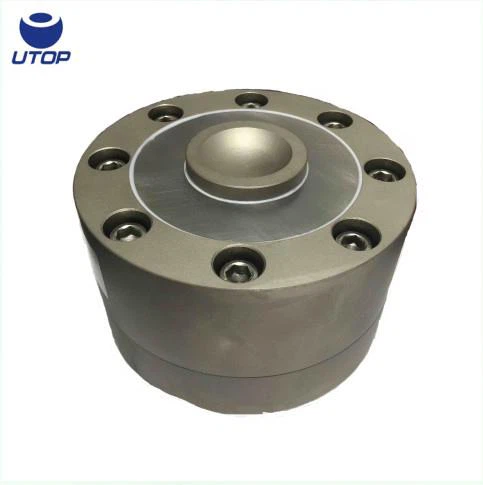
At our company, we offer a wide range of load cells to meet your needs. Whether you're looking for a Compression Load Cell, Stainless Steel S Type Load Cell, or Alloy Steel S Load Cell, we've got you covered. Our load cells are designed with high precision and low uncertainty to ensure reliable and accurate measurements.
Conclusion
Calculating the uncertainty of a load cell is an important step in ensuring the accuracy of your force and weight measurements. By understanding the factors that affect uncertainty and following the steps outlined in this blog post, you can calculate the uncertainty of your load cell and make informed decisions about its suitability for your application. If you have any questions or are interested in purchasing a load cell, feel free to reach out to us for more information and to start a procurement discussion.
References
- OIML R60: Recommendations for Load Cells, International Organization of Legal Metrology.
- ASTM E4: Standard Practices for Force Verification of Testing Machines, American Society for Testing and Materials.