

What is the principle of a level transmitter?
Jan 09, 2026
Hey there! As a supplier of level transmitters, I often get asked about the principle behind these nifty devices. So, I thought I'd take a moment to break it down for you in plain English.
Let's start at the basics. A level transmitter is a device that measures the level of a liquid or solid in a tank or container. It then converts this measurement into an electrical signal that can be sent to a control system or display. This allows operators to keep an eye on the level of their substances and take action when needed, like refilling a tank or preventing overflows.
There are several types of level transmitters out there, each with its own unique principle of operation. But the most common ones fall into a few main categories: hydrostatic, ultrasonic, radar, and capacitive.
Hydrostatic Level Transmitters
Hydrostatic level transmitters work on the principle of measuring the pressure exerted by a liquid column. You know how the deeper you go in a swimming pool, the more pressure you feel on your ears? It's the same idea here. The pressure at the bottom of a tank is directly proportional to the height of the liquid above it.
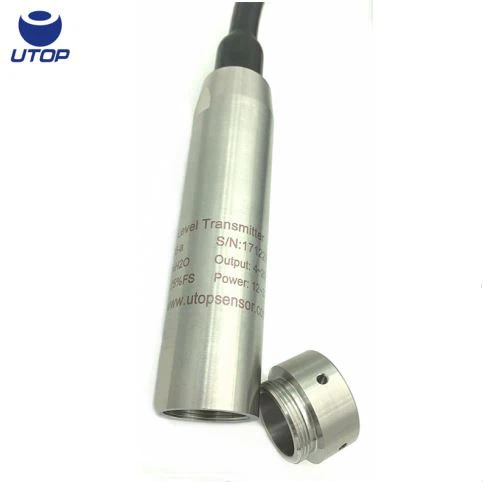

We use a pressure sensor at the bottom of the tank to measure this pressure. The sensor converts the pressure into an electrical signal, which is then processed by the transmitter. The transmitter takes into account the density of the liquid and some calibration factors to calculate the actual level of the liquid in the tank.
These transmitters are great because they're simple, reliable, and can work with a wide range of liquids. They're commonly used in applications like water tanks, oil tanks, and chemical storage. If you're looking for an Oil Level Sensor, a hydrostatic one might be a good choice.
Ultrasonic Level Transmitters
Ultrasonic level transmitters use sound waves to measure the level of a substance. The transmitter sends out high - frequency ultrasonic waves towards the surface of the liquid or solid in the tank. When these waves hit the surface, they bounce back (echo) to the transmitter.
The transmitter measures the time it takes for the sound waves to travel to the surface and back. Since we know the speed of sound in air (or the medium in the tank), we can calculate the distance from the transmitter to the surface of the substance. Subtracting this distance from the total height of the tank gives us the level of the substance.
One of the advantages of ultrasonic level transmitters is that they're non - contact. This means they don't have to touch the substance being measured, which is great for measuring corrosive, viscous, or dirty materials. However, they can be affected by factors like temperature, humidity, and the presence of foam or dust in the tank.
Radar Level Transmitters
Radar level transmitters operate on a similar principle to ultrasonic ones, but they use electromagnetic waves (radio waves) instead of sound waves. The transmitter sends out radar waves towards the surface of the substance in the tank. When these waves hit the surface, they are reflected back to the transmitter.
The transmitter measures the time it takes for the radar waves to travel to the surface and back. By knowing the speed of light (which is the speed at which radar waves travel), it can calculate the distance to the surface and thus the level of the substance.
Radar level transmitters are very accurate and can work in a wide range of industrial applications. They're not affected by factors like temperature, pressure, or the presence of dust and foam in the same way that ultrasonic transmitters can be. They're commonly used in applications where high accuracy is required, such as in the oil and gas industry.
Capacitive Level Transmitters
Capacitive level transmitters work based on the change in capacitance. Capacitance is a measure of an object's ability to store an electrical charge. The transmitter has a probe that is inserted into the tank. The capacitance between the probe and the tank wall (or a reference electrode) changes depending on the level of the substance in the tank.
When the probe is in contact with a liquid or solid, the dielectric constant of the medium around the probe changes. Since capacitance is related to the dielectric constant, a change in the level of the substance causes a change in capacitance. The transmitter measures this change in capacitance and converts it into a level measurement.
Capacitive level transmitters are suitable for measuring both liquids and solids. They're simple, easy to install, and can work well in applications where the substance is conductive or non - conductive. For instance, our PVDF Housing Level Transmitter uses capacitive principle in many cases, and the PVDF housing makes it resistant to corrosion.
Our Range of Level Transmitters
At our company, we offer a wide variety of level transmitters to meet different customer needs. Our RS485 Level Transmitter is a popular choice. The RS485 communication interface allows for long - distance communication and easy integration with control systems.
Whether you need a level transmitter for a small water tank in your factory or a large oil storage tank in a refinery, we've got you covered. Our products are known for their high quality, accuracy, and reliability. We've spent years perfecting our technology to make sure that our level transmitters can withstand the tough conditions in various industrial environments.
Why Choose Us?
We're more than just a supplier. We're your partner in finding the right level measurement solution. Our team of experts is always ready to help you choose the best level transmitter for your specific application. We can provide you with in - depth technical advice, installation guidance, and after - sales support.
We understand that every customer has unique requirements. That's why we offer customized solutions. If you need a level transmitter with specific features or specifications, we can work with you to develop a product that meets your needs exactly.
Contact Us for Purchasing
If you're in the market for a level transmitter, whether it's a Oil Level Sensor, an RS485 Level Transmitter, or a PVDF Housing Level Transmitter, don't hesitate to reach out. We're here to answer all your questions and help you with your purchasing decision.
Let's work together to ensure that you have the best level measurement solution for your business. Contact us today and let's start the conversation!
References
- Level Measurement Handbook, Written by experts in the field of industrial instrumentation.
- Industrial Measurement and Control Technology Journal Vol. XX, which provides in - depth research and case studies on level transmitters.